Priority
Transportation
Better roads, multi-use paths and sidewalks
Just as Boulder faces a backlog of deferred maintenance for its public facilities, our roads need repair, especially on major routes. Taking care of our streets, multi-use paths and sidewalks is a basic responsibility of city government.
For many residents and visitors, cars will continue to be their first choice for getting around Boulder. Our transportation policies should recognize that reality. We can make bicycling, walking and transit more attractive while keeping downtown and the rest of the city accessible by automobile. There is room for both.
Road repairs cost money, and I believe Boulder has a strong case for greater county and state investment in our transportation system. People come here for the University of Colorado, arts and culture, recreation, scientific research and business. Our streets serve people from well beyond the city limits.
If elected, I will work with county officials and our state legislators to pursue funding for projects that serve those broader needs. We should be prepared to show which improvements deserve support and what that investment will accomplish.
The city should explain which repairs come first, what they will cost and when they will be completed. Residents should be able to find out when their street or a route they use every day is scheduled for work.
Build on Boulder’s vision for bicycling
Like so many people who come to Boulder, I developed a passion for bicycling. First came the carbon fiber road bike, followed by the mountain bike with a dropper seat post. These days, an electric hybrid city bike gets me downtown.
Earlier bicycle advocates understood that dedicated paths could make riding through Boulder more attractive by reducing potential interactions with cars. Their vision helped create a network we use for both transportation and recreation.
We should continue that work by maintaining our paths, filling gaps and improving connections to shops, schools and workplaces. Separation from cars can make the difference for someone who wants to bicycle but is uncomfortable riding in traffic.
We also need better options for locking up a bicycle when we arrive. Convenient racks, covered parking and secure storage should be part of our transportation planning. People are less likely to ride to a business if they are worried about leaving their bicycle or e-bike outside while they shop, eat or work.
Choose improvements that fit the street
I support safer bicycling, but we do not need a one-size-fits-all approach to adding bike lanes. Each street serves different purposes, and its design should reflect how people use it.
Protected bike lanes, separate paths and improvements to nearby bicycle routes should receive a fair evaluation. We need to consider safety, direct connections, traffic on surrounding streets and access for businesses and emergency vehicles. A nearby bicycle route is useful only if it provides a safe and convenient way to get where people want to go.
Adding bike lanes should not automatically mean reducing vehicle lanes. Before making that change on a major road, the city should listen to the people who depend on it, explain the alternatives and show why the proposed design is the best choice.
I do not support making automobile access more difficult as a way to discourage driving to our commercial areas. We should welcome people who drive to our shops, restaurants and other businesses, just as we welcome those who arrive by bicycle, on foot or by bus.
Test the proposed changes to Iris Avenue
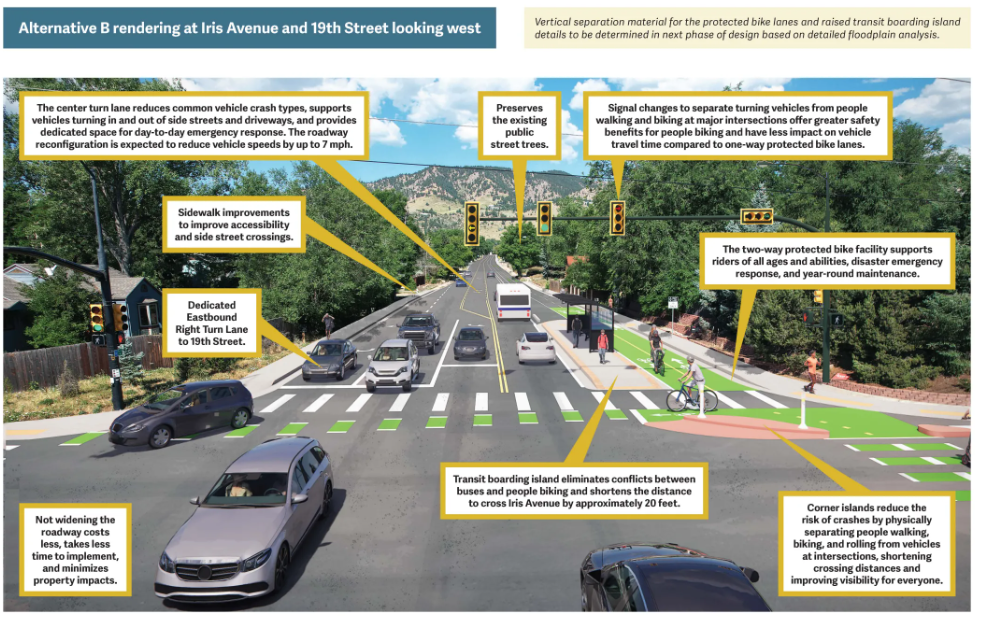
I oppose converting Iris Avenue to a three-lane road without first conducting a meaningful trial. Iris is a major east-west route in north Boulder, and people who live and work in this part of the city depend on it.
I understand the transportation experts say these revisions won’t significantly increase travel times, but no one who drives on Iris Avenue sees that. People who live and work in this part of the city appreciate having two lanes of traffic going both ways.
A trial of the Iris Avenue plan could be as simple and inexpensive as placing cones along the proposed lane modifications. The trial should be long enough to include ordinary commuting and school traffic. We should examine travel times, traffic diverted onto neighborhood streets, access to businesses, emergency response delays, and whether biking along Iris increases.
Without a simple trial of the proposed lane reduction, losing a traffic lane for the possibility that a few more people will bike from Broadway to 28th does not seem to be worth the tradeoff. An example of this type of tradeoff is Folsom Avenue. While we can be proud of making Folsom safer for biking, no one sees greater bike usage between Valmont and Arapahoe. Before making a similar commitment on Iris Avenue, let’s test whether the plan works in the everyday lives of the people in north Boulder.
My concern extends beyond Iris Avenue to how the city approaches transportation projects. When residents raise legitimate concerns, it is not enough to tell them that change is hard. Leadership requires asking whether we are serving the community.
Make bicycling, e-bikes and e-motos more predictable
People using our streets and paths should know what to expect from one another. Someone walking a dog should not be surprised by a fast-moving electric vehicle passing closely from behind. Drivers and bicyclists should be able to anticipate each other’s movements at intersections.
Bicycles, e-bikes and e-motos are different, and the city should make the rules understandable. People need to know where each can be ridden and what is expected of the rider.
E-motos have a place as a transportation option. We need to address their safe use while recognizing that value. For teenagers, parents have an important responsibility to teach and reinforce safe riding practices, including appropriate speeds, yielding to others and following the rules for streets and paths. Parents also face legal liability when their children choose not to follow these rules.
The city has a responsibility as well: explain the rules clearly and enforce them consistently when people put others at risk. Everyone using our streets and paths should be expected to do so safely.